
Simon David Eden on creativity as alchemy, defying expectations, and why it’s so important to give back
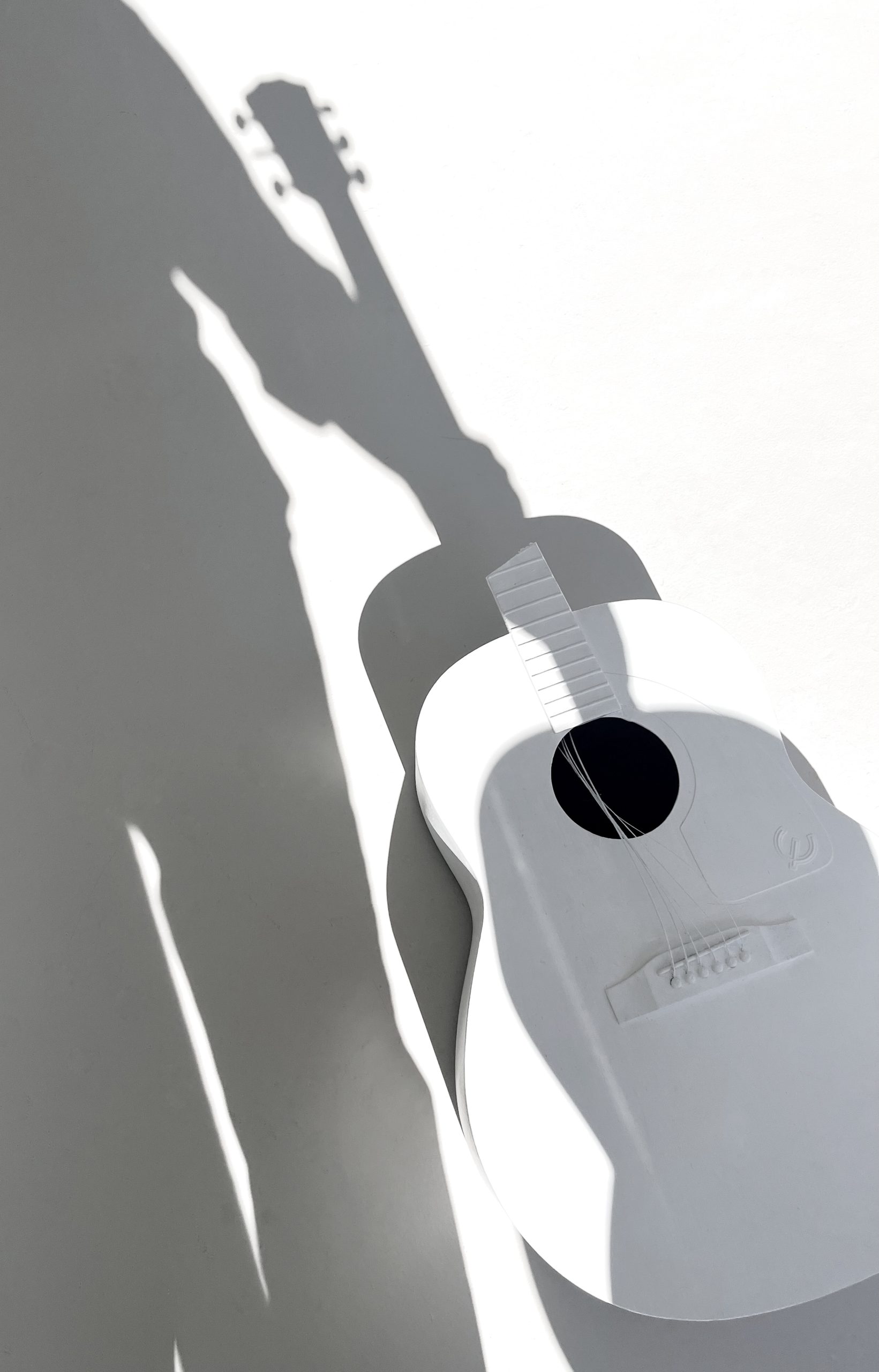
Shadow Light: Songs My Brother Taught Me is your first solo exhibition in nearly two decades. It touches on themes of brotherhood, grief and connection – and was inspired by a very personal and tragic event in your life. I wonder if you would mind telling us more about this?
My brother Stephen tragically took his own life at age 20 in 1976. It was the same year that punk exploded onto the scene and rewrote the rules, making creative expression through music seem way more accessible than it had ever been before. I didn’t know my brother was songwriting until just before we lost him forever, but I’d been making art and experimenting with free verse and abstract poetry for a decade already, so using that as a basis to form a band gave me a vessel into which I could pour my pain, grief, anger, fear and confusion. I was definitely in denial at the time, trying to escape from reality through performance art and making noise, but reflecting on that period now, music and performance was my salvation and I felt like I had to forge my way as an artist for both of us.
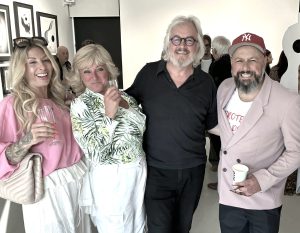
Simon David Eden with Tracey Starr (Starr Trust) and Sam Thomas (Different Hats: You Alright Mate?) at Shadow Light exhibition launch
I love the title of the show – can you elaborate on where this came from?
Regarding Shadow Light I was referencing French philosopher Albert Camus: ‘There is no sun without shadow, and it is essential to know the night.’ I interpret that as meaning we all face adversity, suffering and dark periods but that in turn enables us to appreciate all that makes life worthwhile: love, happiness, sunlight, freedom. The Songs mentioned in the title are symbolic, they are not songs at all (as my brother burned all of his writing) but rather they are feelings, emotions, the eternal connection.
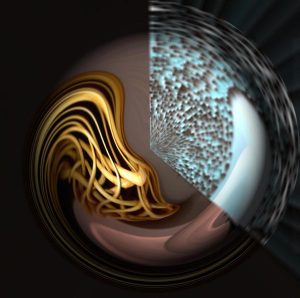
“Schauberger’s Spiral,” Weight of Fire series 2005
It has been a long time since your last exhibition at the 2nd Art & Science Symposium & Exhibition at the Tsinghua Academy of Arts in Beijing in 2006? Could you let us into what you have been doing in the intervening years – I know you have been very active! – and why it seemed like the right moment to show your art again?
The invitation to exhibit in Beijing came immediately after my debut solo exhibition The Weight of Fire at a gallery on the Kings Road, Chelsea. In the intervening years I’ve written two dystopian eco-fantasy novels The Savage Kingdom #TSK1 & #TSK2 (available on Amazon!) and written, designed and directed two indie stage plays The Gift of the Gab and The Albatross 3rd & Main. The latter was published by Samuel French. I also co-wrote a R&B album entitled The Road Will Rise with keyboard wizard Tony O’Malley (ex-10cc, Kokomo, Arrival) and I’ve had an indie feature film in development for six years now, which looks set for me to direct in Romania later this year with the amazing Rosanna Arquette, Aidan Quinn and Madalina Bellariu Ion starring. As the new exhibition – twenty years in the making – is such an intensely personal story, I wanted to ensure I could give it one hundred per cent focus before I get lost in the all-consuming film production process.
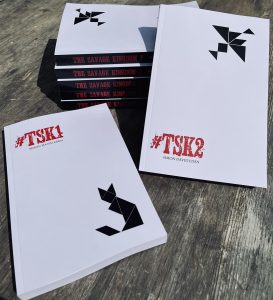
The Savage Kingdom novels 1&2
Can you give us a taster of what visitors can expect from the exhibition? I believe you are showing 20 works – including abstract fine art, prints, collage, assemblage, autofiction and visual storytelling…
20 artworks each a Limited Edition of 20, to mark the 20 years of my brother’s short life. Three of the works are collage. There’s sculptural assemblage representing the darkest period of despair and bereavement, and the majority of the works are uplifting photographic prints featuring the first acoustic guitar I ever owned (broken accidentally 20 years ago). I’m constantly being told that the combined works have created a wonderful sense of serenity, peace and communion in the space which is incredibly gratifying.
The emotional response from those visiting the show to date has been extraordinary. Everyday there have been strangers moved to tears (in a good way) keen to engage in conversation, share their own stories of loss, or just to express their thanks that the concept is designed to help remove the shame and stigma that’s still related to struggles with mental health, which is sadly widespread in our society.
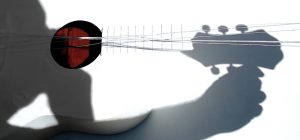
A limited edition photographic print from the ‘Shadow Light: Songs My Brother Taught Me’ series/exhibition
You began creating at a very early age, making comics at age 10 before moving into surrealist poetry, songwriting, performance art, film and screenwriting. Your career path is extremely wide-ranging and covers an extraordinarily diverse range of activities and genres. Do any of these other forms of artistic expression find their way/inform in some way your current art pratice?
There is an abstract poem in the show (influenced by the style of e. e. cummings) that sets the tone and context for all the other art works, which seems to resonate very powerfully with people. My wonderful friends, actors Imogen Stubbs and Jonathan Guy-Lewis dropped by last week and they remarked on how the sculptural assemblage could almost be the centre piece for a stage play. In some senses I feel it already is, as whatever field of artistic expression I’m working in, there’s always subtext and narrative.
You describe yourself as a “creative polymath.” Can you explain what this term means for you and why creativity is so important to you – and specifically in relation to men’s emotional wellbeing?
For me it means having the freedom to allow each idea to be expressed in whatever form best suits it. Creativity is a kind of incredible alchemy, and quite often the work tells me what it wants to be and I’ve learned to simply trust that instinct and inner voice. It’s cost me agents, managers and many potential jobs over the years, and I’d have certainly made considerably more money if I’d stuck with one discipline (like writing TV drama for example) but for some reason it’s in my DNA to jump the guard rails, defy expectations and follow the muse. Which is way more fun and challenging and I’m content my body of work justifies hanging on to that integrity. In terms of men’s emotional wellbeing, I do believe engaging in the arts of any kind (dance, singing in a choir, painting, learning to play an instrument etc) is a very positive therapeutic activity and a great step towards being open to express deep feelings that can often be difficult to talk about.
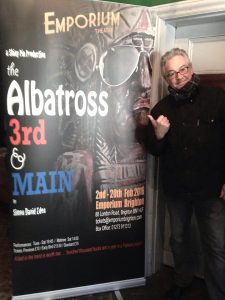
Albatross 3rd & main stage play poster
You recently collaborated with mental health advocate Sam Thomas on his podcast Different Hats: Are You Alright Mate? Can you explain to us why you feel it is vital that artists use their platforms in this way? And how art can contribute to the wider discussions around male mental health?
Feel blessed to have met Sam. The man is an absolute legend. A true inspiration, doing vital and incredible work. We’ve spoken about collaborating on a project with male mental health at its core, which I’m hoping will come to fruition next year, but its early days so I’m not sure quite what form that might take. Still waiting on the muse to guide me!
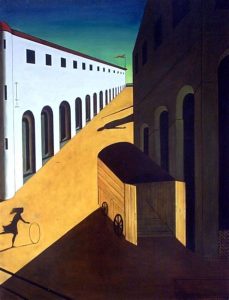
Giorgio de Chirico “Mystery and Melancholy of a Street” 1914
Surrealism has clearly been of primary interest in many of your creative endeavours. Can you go into why it holds such a fascination for you? Are there any Surrealist works/artists/movements that have been a particular influence?
I recall being mesmerized by Giorgio de Chirico’s painting Mystery and Melancholy of a Street which I saw in a magazine. I must have been around thirteen. It had a really unsettling quality to it, the girl playing with the hoop, the open wagon, the shadow of someone lurking behind the tall arched building. It seemed to demand that you fill in the blanks and create a narrative to see how things might unfold. Later on, I was drawn to the elegant, sensual, cinematic photographs of Man Ray and the surrealist poetry of Paul Eluard. Though she wasn’t a part of that group or movement, I instantly fell in love with the photographs of the revolutionary force of nature that was Tina Modotti. Some years ago the wonderful Italian film producer Fernando Ghia approached me about writing a screenplay about her life. Sadly he passed away before we could get to work on it. I suppose being invited to the ICA in 1980 by Roland Penrose (the godfather of British Surrealism) to see the first screening in this country of Buñuel & Dali’s L’Âge d’or was the pivotal moment in which I shed my imposter syndrome and realised I had found, and was welcomed by, my artistic tribe. Collaborating with iconic author J.G. Ballard for ten years was also a high point (although our TV series adaptation of his short story collection Vermilion Sands hasn’t yet made it to the screen).
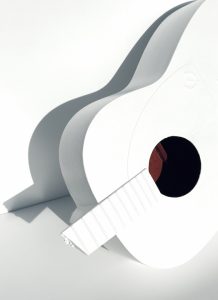
A limited edition photographic print from the ‘Shadow Light: Songs My Brother Taught Me’ series/exhibition
You were born and grew up in Moulsecoomb, but have worked and exhibited in London – and internationally – for many years. How does it feel to be showing in your hometown? Does Brighton Fringe and Artists Open Houses offer something specific as a platform for your work and motivation to increase dialogue around men’s mental health?
I’ve long wanted to exhibit in my hometown but I’d never been invited previously. I’ve no idea why. Given my local roots and the personal story behind the Shadow Light body of work, I’m thrilled to finally have the chance to show my artworks here, and to have been able to align with Sam Thomas and the amazing Rose Rowkins’ Start-the-Conversation suicide awareness training programme. Coming from Moulsecoomb, I guess I’ve always been something of an underdog outsider (and clearly flying under the radar of the Brighton Festival organisers despite a career spanning five decades) so I’m very grateful for the brilliant platform offered by the AOH and the Brighton Fringe.
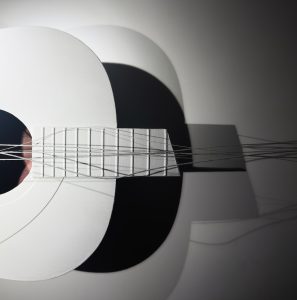
A limited edition photographic print from the ‘Shadow Light: Songs My Brother Taught Me’ series / exhibition
In recent years you have supported young creatives through Creative Access, taught playrighting at Chichester Festival Theatre, and delivered free creative writing workshops to Brighton’s rough sleeper community through Word on the Street. Can you tell us what you feel you have to offer the next generation of artists and why it is important to give back to the community?
Early on in my career I benefited enormously from the selfless mentorship of incredibly talented established professionals who were very generous with their time, patience and wisdom honed through years of experience. It gives me the greatest joy and satisfaction to be able to do the same and light a spark or two in the next generation. And given my background, being able to demonstrate by example that wherever you hail from, however impossible the journey and ambition might seem, if you dare to follow your dreams, your dreams will follow. Maybe not entirely how you imagined, or by the route expected, but that’s OK. That just makes the rollercoaster ride of a creative life all the more exciting.
Visit: Shadow Light: Songs My Brother Taught Me
Phoenix Project Space, 10-14 Waterloo Place, Brighton, Glassart
No.12 on the Hanover trail
www.simondavideden.com
@simondavideden