
Tony Mentel on celebrating queer joy, finding one’s tribe, and the homoerotic power of religious art
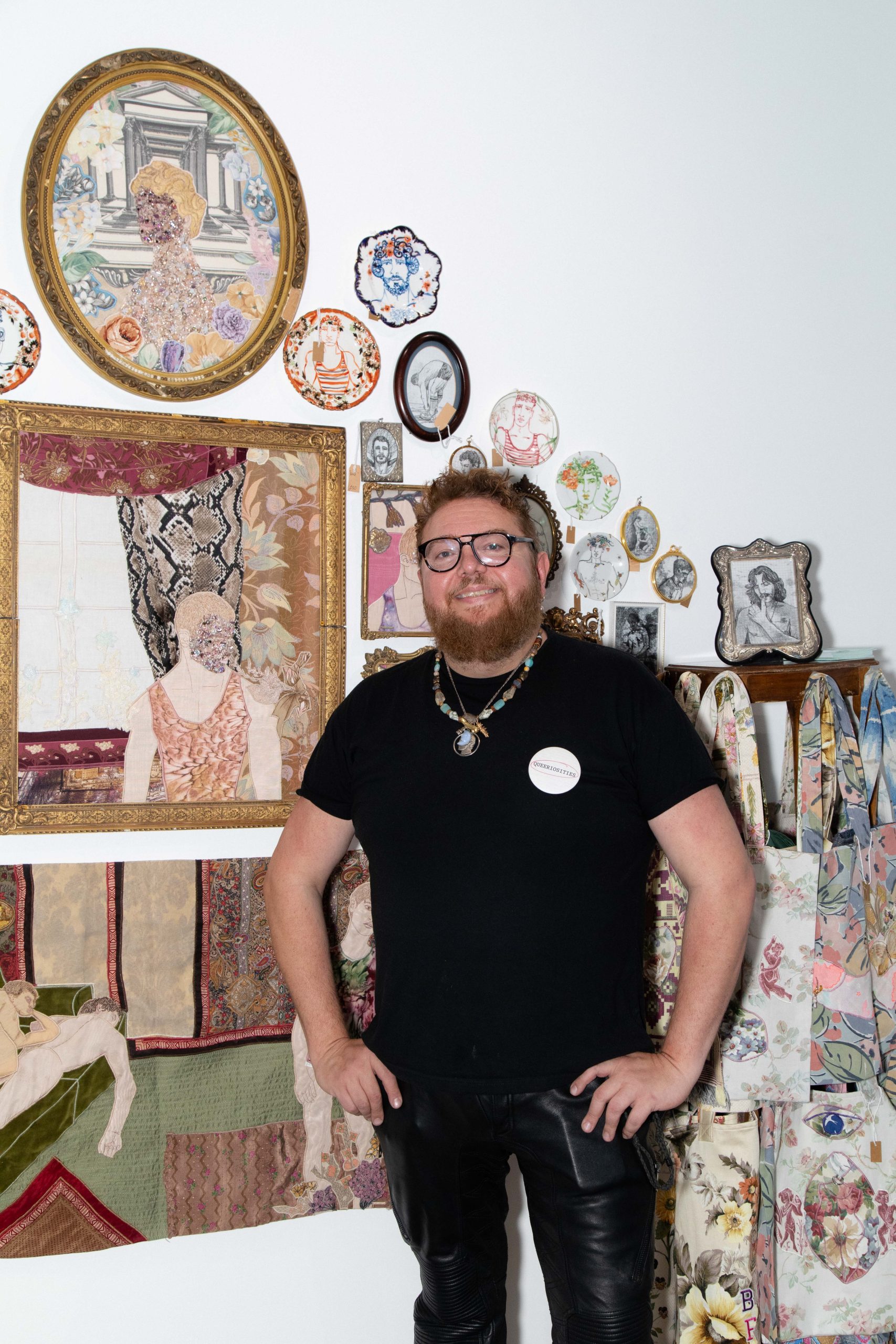
Hi Tony – The Adelaide Salon is presenting an exhibition of your work entitled The Male Gaze, as part of the Open Houses this year. Can you tell us how it came about and what you will be showing?
I met Paulina and Pascal from the Adelaide salon about 2 years ago after I applied to be part of an open call they were holding. I showed them my work and they asked me if I would be interested in creating a solo show. I love what they are doing in the Brighton Art scene, it’s really innovative and inspiring, and it’s such an amazing space and collaboration partners.
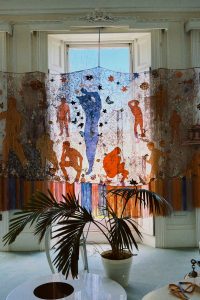
“Night at the temple” 2026
The show is dedicated to a couple, George and Harry, whose story touched you in a very personal and direct way. Can you tell us a bit more about this?
I grew up In a small town called Waltham Abbey in Essex, during the time of section 28 and the AIDS crisis. I always knew I was different and the only role models I had of gay life were Harry and George, a couple who ran the art and book store and tea shop. They did it with such flair and style, they were both dashing, sophisticated and handsome, even as a kid I knew they were like me, before I even knew what gay was. Sadly George became very ill, and died of AIDS early on in the epidemic, then Harry left town and I don’t know what happened to him. At that time the town was not kind to them, and how they were treated scared me and pushed me firmly back in the closet. I dedicate the show to their memories, as they were a beacon of hope for me in a cruel time.
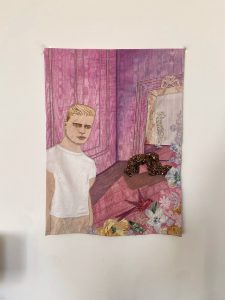
“Pink Interior” (2024), Embroidery, applique work, beading, vintage textiles
The shaping of queer narratives by persecution, and their necessary concealment in art, is at the forefront of your work. Could you explain in a bit more detail how this informs your choice of medium and the formal decisions you make?
Most LGBTQ history has been sadly lost, never recorded for fear of persecution. So often the only story’s we hear are from those who were prosecuted or infamous. I want to celebrate the lives of those people who have been lost in time, revel in the love they shared and the wonderful lives that were lead. I want to celebrate queer joy, through beauty and colour and vibrance and detail. I make tapestries from recycled fabrics and embroidery and beads. Working with textiles feels so queer as a man, because of it’s feminine connotations, delicacy and intricacy. It takes patience and meditation, and also the fabrics hold such magic, they have a story to tell, they might have been worn, slept in, lived around and treasured. To me fabric holds memory and history, it bears witness to our lives and so holds memory and nostalgia.
The idea of transformation or metamorphosis is also central to your practice, and is reflected both in your subjects and in the materials you use. Can you elaborate?
My work tells of how we transform as we discover where we belong, our tribe, ourselves. It’s about a discovery of love and joy, when we sincerely accept who we truly are, we are finally able to accept love. There is an intangible magic in love and community that I try to convey in my work.

Life size ceramic bust with Agate and Bronze adornments
As well mythological imagery, religious iconography also features strongly in your work. I am interested what the language of the sacred offers you – especially given its long and well-documented antipathy towards queer identities and narratives?
We grow up being shown religious art, saints and myths, it becomes part of our subconscious visual language. I want to use the familiar but rewrite the narrative to a more queer friendly story. Religious art can be very homoerotic: I also recently read an amazing book by Seàn Hewitt in which he translate texts from ancient Greek and Roman literature, which had been censored in the past and had their queer themes erased. It’s called 300,000 kisses, and it’s glorious.
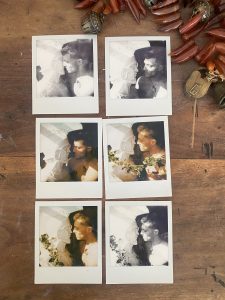
Polaroids, Jake 2026
Many of your works are of an intimate, and at times voyeuristic, nature. I am interested how you feel about showing these in an exhibition space that has a more domestic/private vibe – do you think the viewer’s encounter with the work might be affected/enhanced by this?
I’m really intrigued to see how people will react, the house I’m showing in is very grand and elegant, the former home of a very wealthy family, setting my work in there gives it weight and power, and also feels quite subversive as I have scenes of homoerotic love gracing the walls of of such a noble residence. It also feels quite vulnerable as this work really speaks of my personal journey. So I must say it’s felt rather emotional to hang the work.
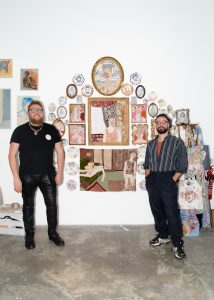
“Queeriosities” at the Copeland Gallery, Peckham, London 2025
You have exhibited in both London and Brighton – where you also live and work – as well as in Berlin. I was wondering how your experience differs in each? They all have their own, equally strong, but very different queer communities and audiences? I know I am not totally impartial here, but I imagine it is must be particularly nice to show in your hometown, amongst friends?
It’s feels wonderful to be showing in Brighton, I really feel like part of the community here and very supported. The queer community here is more gentle and nurturing, Brighton is where I feel most at home.
Berlin is one of my favourite cities, I lived in Germany from 1998-2008 and have wonderful memories of one of the most creative and hedonistic places on earth in its heyday. The queer scene there is so full of rebellion and energy it’s invigorating.
London is where I was born, and I also studied at the Royal College of Art there, so it also feels like home, but it doesn’t have the intimacy that Brighton has. I find the city so exciting, the queer scene is very creative and vibrant, but I must say after a few days I’m normally happy to be heading back to the sea. I take a deep breath as I get off the train in Brighton station and feel immediately calmer.
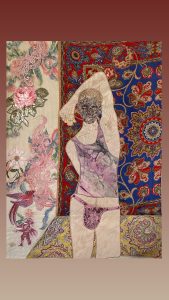
“Berlin Interior III” (2024) Embroidery, applique work, beading, vintage textiles
The Adelaide Salon is a well-known and beloved Brighton & Hove Institution, which draws on the concept of the 19th Century French salon to create “a ‘space’ where life and art become one”, where cross-disciplinary exchange is nurtured, and where “‘Liberté’ of mind and expression” is championed (specifically “to not be defined by definition or perceived constraints”). It strikes me a particularly appropriate setting/context for this exhibition – is this something you feel too?
Yes it is the perfect space to show my work, on Thursday my private view will also feature some queer performance from Mx Misha MN, and we are aiming to create a space of discourse, discovery and delight. Rather than a traditional sterile gallery setting, this grand home presents the ideal setting for a salon, where people meet and ideas form, as well as looking at art.
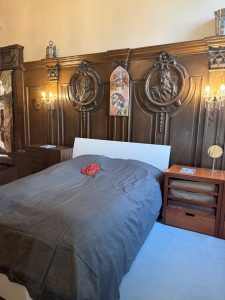
The Male Gaze (installation view) 2026
A question (or two) too for Pascal and Paulina (The Adelaide Salon): was there something specific that drew you to Tony’s practice initially?
What first drew us to Tony Mentel’s practice was a quiet discipline in his use of material—needlework, tapestry, ceramic, mark-making—that carries with it a deep historical weight, yet navigates the tension between surface and narrative. At first encounter, there is a refinement, even a delicacy. But very quickly, something else begins to emerge—layers of coded histories, of desire, of suppression and expression held in suspension. The works seem to operate as vessels: holding stories that have not always been permitted direct visibility. The labour, the repetition, the devotion to process—these are not neutral acts. They carry a kind of presence, almost ritualistic, which aligns closely with our interest in art as something lived, enacted, and encountered rather than simply observed. It was a recognition of a practice that holds complexity with restraint—one that invites a slower form of attention, and in doing so, reveals something far more enduring.
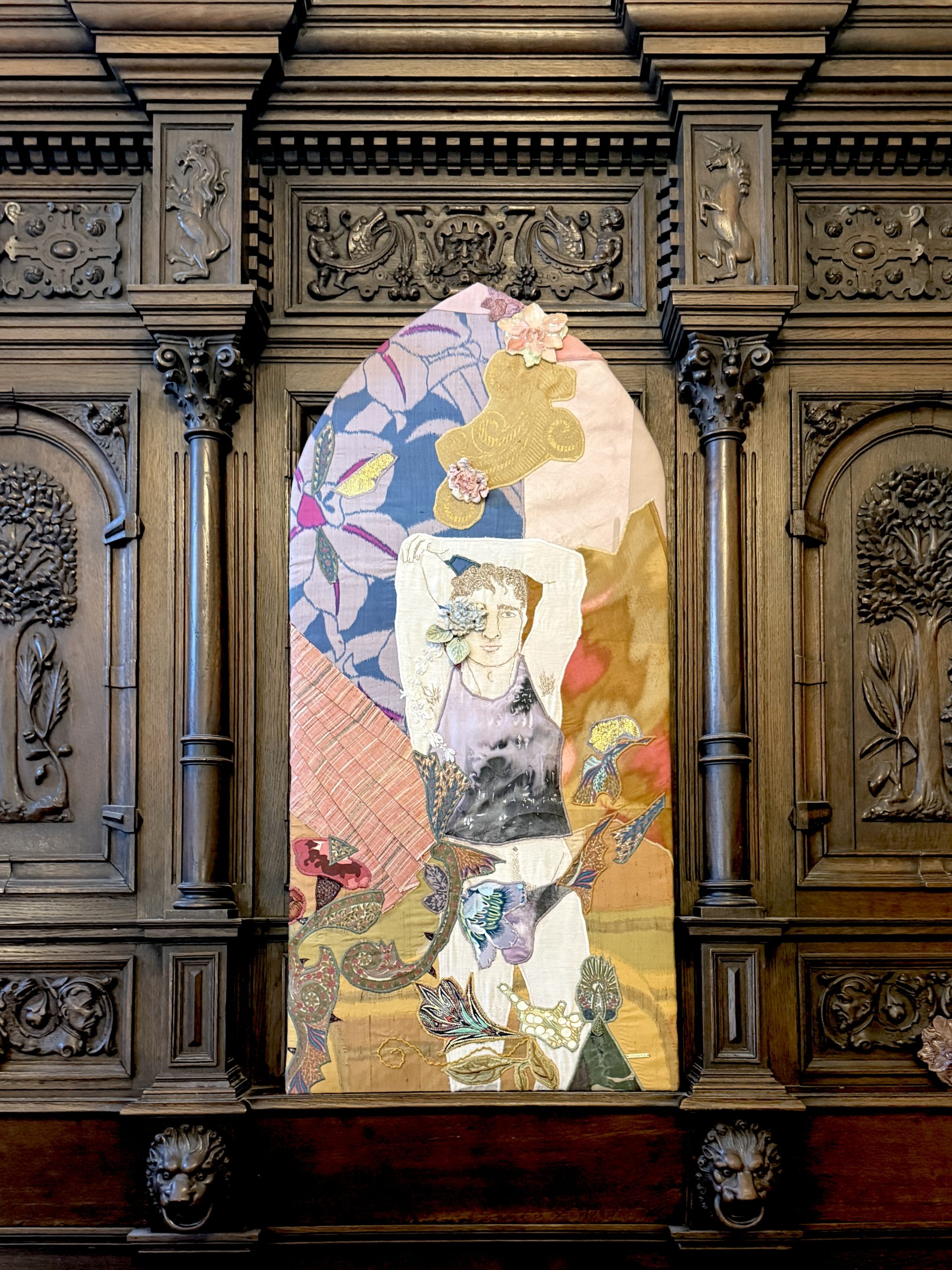
Embroidery, applique work, beading, vintage textiles
How did you discover his work? And how do you feel it connects with the Adelaide Salon’s motivations and overall philosophy?
We first encountered Tony’s work circulating within the wider field of artists and conversations that we are continuously attentive to. What struck us early on was its refusal to resolve quickly. In a landscape where so much work seeks immediacy, visibility, or declaration, Tony’s practice operates differently. It withholds, it accumulates, it asks for duration. This connects very directly with the motivations of The Adelaide Salon. We are interested in practices that do not simply present themselves as finished objects, but as sites of ongoing enquiry—works that carry within them traces of process, of lived experience, of time. Tony’s work aligns with this through its material intelligence and its embedded narratives. It is not illustrative; it is investigative.
There is also a shared concern with how meaning is constructed and transmitted. The Adelaide Salon often operates within spaces of encounter—where audience, artwork, and context are in constant negotiation. Tony’s practice mirrors this. His works are not fixed in what they offer; they shift depending on how they are approached, how long one stays, what one brings to them.
Perhaps most importantly, there is a philosophical alignment around the idea of visibility and concealment. Much of what we do is about creating conditions where something can emerge—not fully, not conclusively, but enough to be felt, questioned, or reinterpreted. Tony’s work embodies this. And in that invitation, there is depth, tension, and a kind of quiet radicality that feels entirely in dialogue with what The Adelaide Salon seeks to cultivate. -not to be missed-
Visit: The Adelaide Salon
27 Adelaide Crescent, Hove, BN3 2JH
No. 6 on the Hove trail
www.theadelaidesalon.com
www.instagram.com/theadelaidesalon/
@theadelaidesalon