
Ella Berthoud talks about the house of infinite possibility, using her ears to paint with and different ways of seeing…
Ella Berthoud -The Infinite House
Hi Ella,
Your Open House exhibition sounds really interesting and unusual this Winter – not least in its name: The Infinite House. How did it come to be called this?
We are called The Infinite House because there is a book called Piranesi by Susannah Clarke which I love and am slightly obsessed by.
“The House is valuable because it is the House. It is enough in and of Itself. It is not the means to an end.”
“The Beauty of the House is immeasurable; its Kindness infinite…” is a phrase that comes up through the book. The house that Piranesi lives in is seemingly infinite, with tides and strange halls full of statues…our studio feels similar! The tides are not quite coming up yet, but sometimes water comes through the roof. Piranesi is a lost human, and you have to read the book to find out what is going on. He lives in a place of infinite beauty and infinite possibility. When I was trying to come up with a name for our Open House, it seemed appropriate as it’s an unusual place with great architecture, where there is infinite possibility for art, beauty, kindness and mystery…
Can you tell us a little about your guest artists and how you selected them?
Other artists in the House are Hugo Winder-Lind, whose work I love and is very mystical, based on our relationship with animals over the centuries. Hugo’s paintings are in touch with a deep, cthonic past and when you see them you feel one with the landscape.
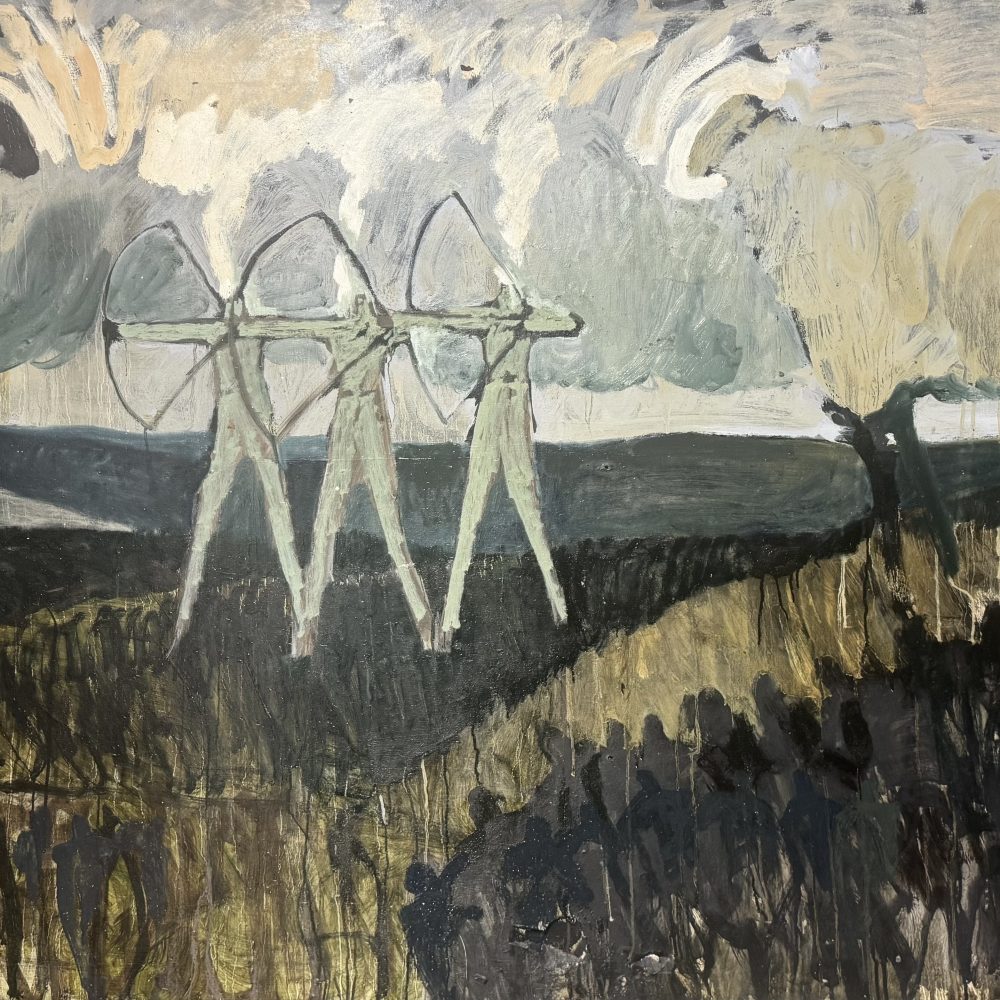
Hugo Winder-Lind – Untitled
Montel Oke is showing in the newer part of the building, with some wonderful street art style paintings on wood, which are colourful and beautifully drawn. Montel takes a line for a walk and is very playful with his imagery.
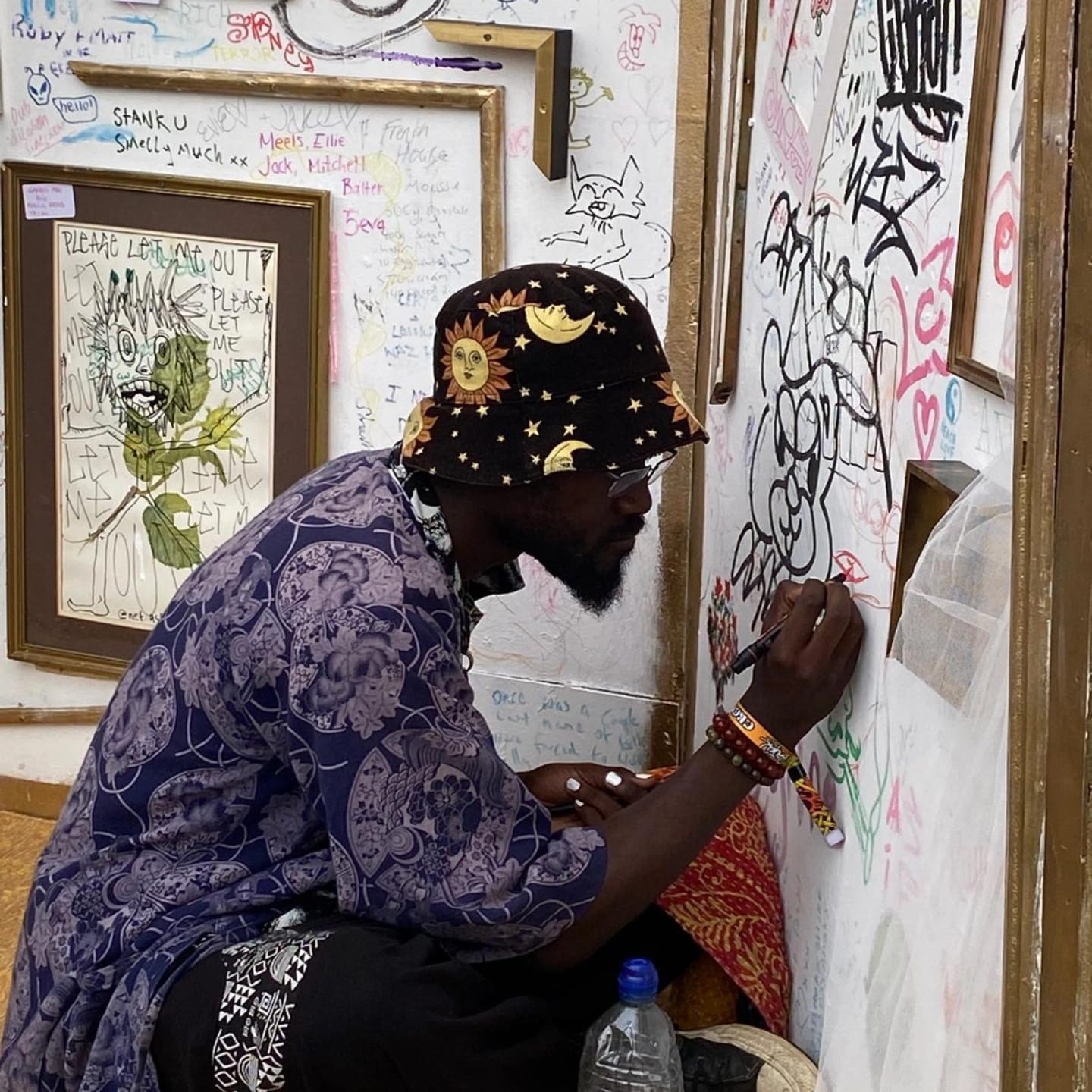 Montel Oke – Untitled
Tim Bates makes amazing light sculptures, which are like little worlds in themselves, sometimes with staircases inside them, sometimes with golden glowing light coming from within – they seem to me very like the idea of the Infinite House where Piranesi lives. Tim and I are old friends from years ago when we were both artists in residence at the Friends School, Saffron Walden.
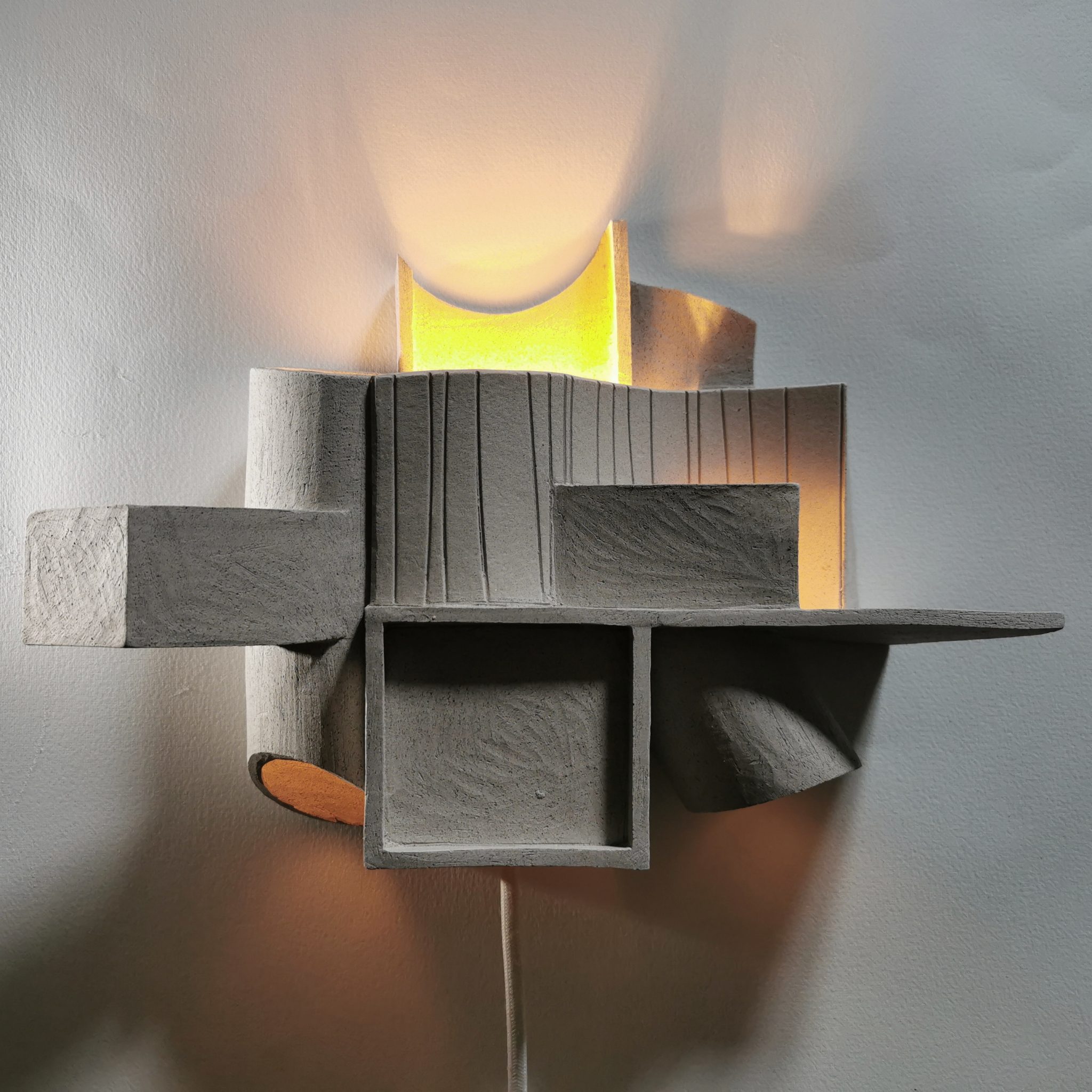 Tim Bates – Skyline wall piece
Edmund Lloyd Winder makes paintings that dance before your eyes, with references to Pan- like figures found deep in the forest, the city or his subconscious.
Ross Borton makes large abstract oil paintings expressing his own psyche, referring to his place in the world, and expressing his deepest feelings in colour.
These are all artists who paint full time in the Infinite House, making exciting art. Tim now lives in France, but is still very involved with the House.
I’m an artist and a bibliotherapist. I started painting when I was 16, and have always loved colour and expressed my love of nature, people and the world through my paintings. I’ve explored music through colour often in my work, and I’m now drawn to investigating sounds on a deeper and more abstract level.
I have a parallel career as a bibliotherapist, and have written several books including The Novel Cure; an A-Z of Literary Remedies, The Art of Mindful Reading, Fiction Prescriptions, and others – I will have these on display at my open house too. I am very influenced by what I read, and the idea for the soundscapes originated from a book called Blindness by Jose Saramago. This book made me think about using my ears to paint with, so to speak.
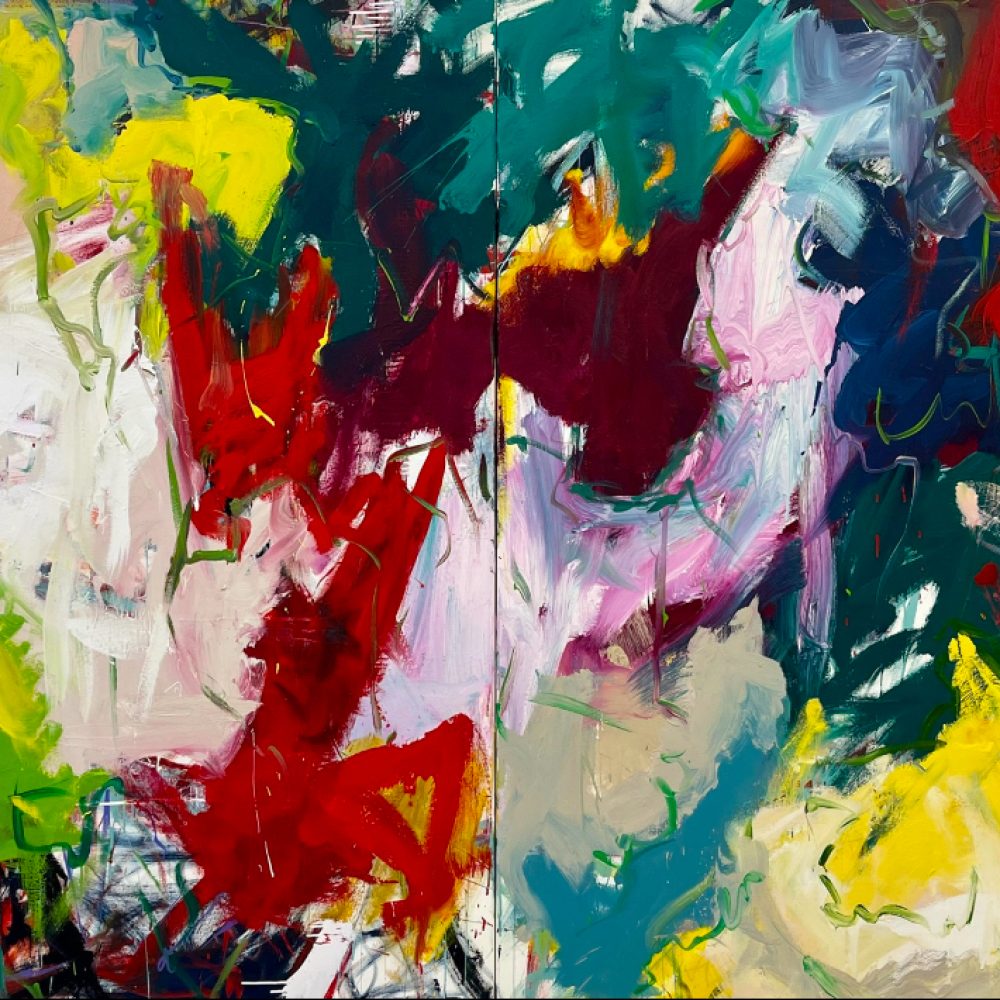
Ross Borton -Untitled
Open House visitors are invited for an exploration of Blindness and Seeing – can you explain this a little and its relationship to Saramago’s quote on the importance of looking?
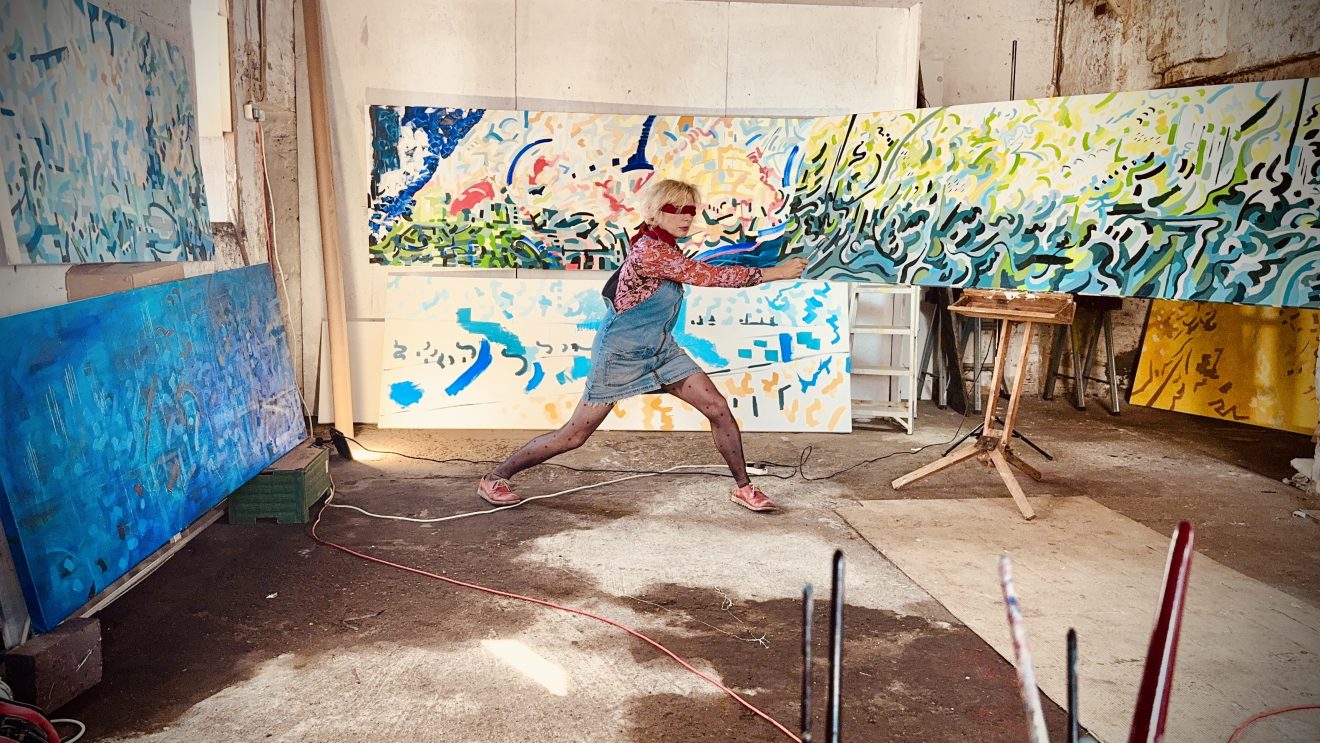
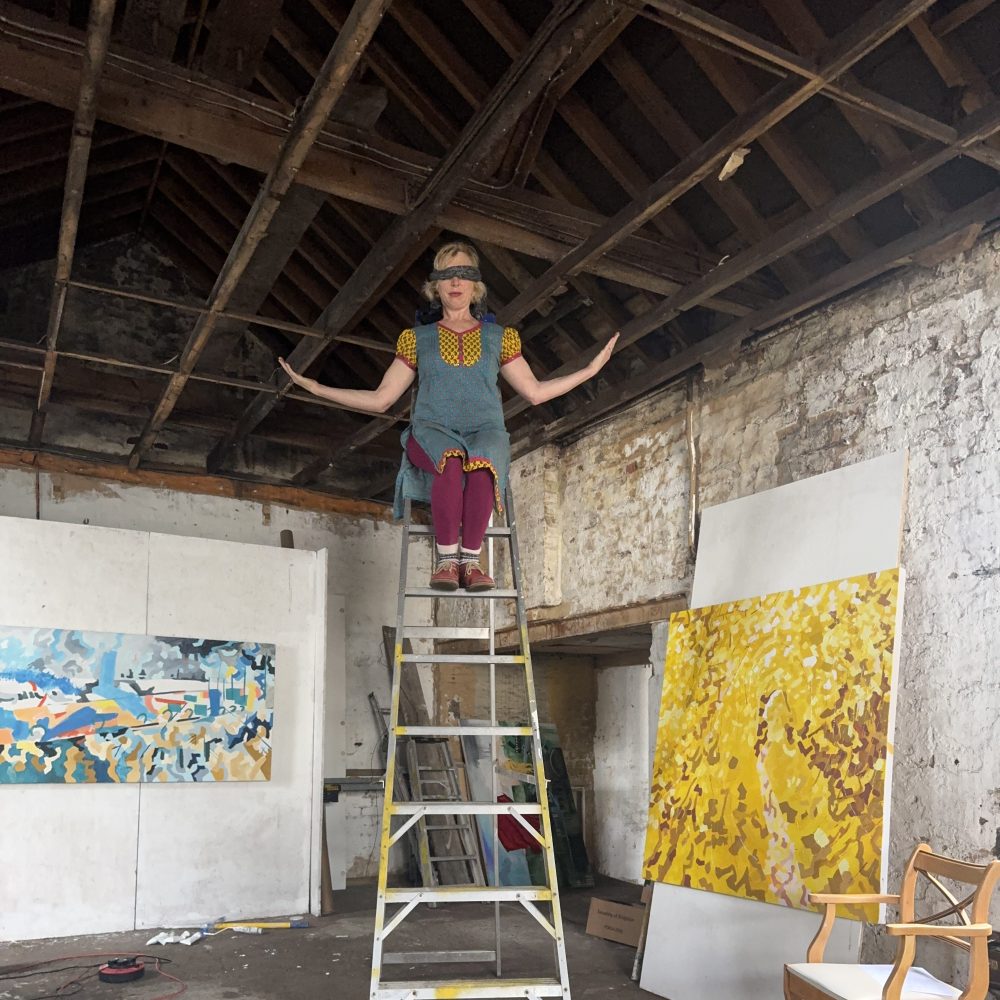
I first read Blindness by Jose Saramago about 25 years ago, and it had a great effect on me. At the time, I blindfolded myself and walked along London’s Embankment holding hands with my husband and thinking about what I heard. I painted some huge paintings based on that experience which I sold. I always wanted to come back to the topic, and having the chance to work in the big studio in College Place gave me that opportunity. I blindfolded myself again and listened to the sounds of the city – Brighton and London Blackfriars and Tower Bridge. Also the sound of the forest in the south downs. I was imagining what it was like to represent sound as colour, and then when I came back to the studio I sketched ideas relating to this, and turned them into the paintings. Bright colours for loud bright sounds, dark colours for dark deep sounds. Quick movements for laughter and light ripples of noise, slow sensual movements for big, bold noises.
Saramago said at the start of his novel, “If you can look, see. If you can see, observe.” This could be an instruction to any artist, but it’s particularly pertinent to his book because everyone in the book (apart from one person) goes blind. The one person left seeing observes everything. But of course the blind also observe, in a new and different way to when they saw before (all of the blind in the book are recently blinded, interestingly- there is no one born blind portrayed in the novel). I wanted to think about seeing in different ways to the way we normally think about seeing. And I hope that observers will see and observe in a new way when they leave the exhibition.
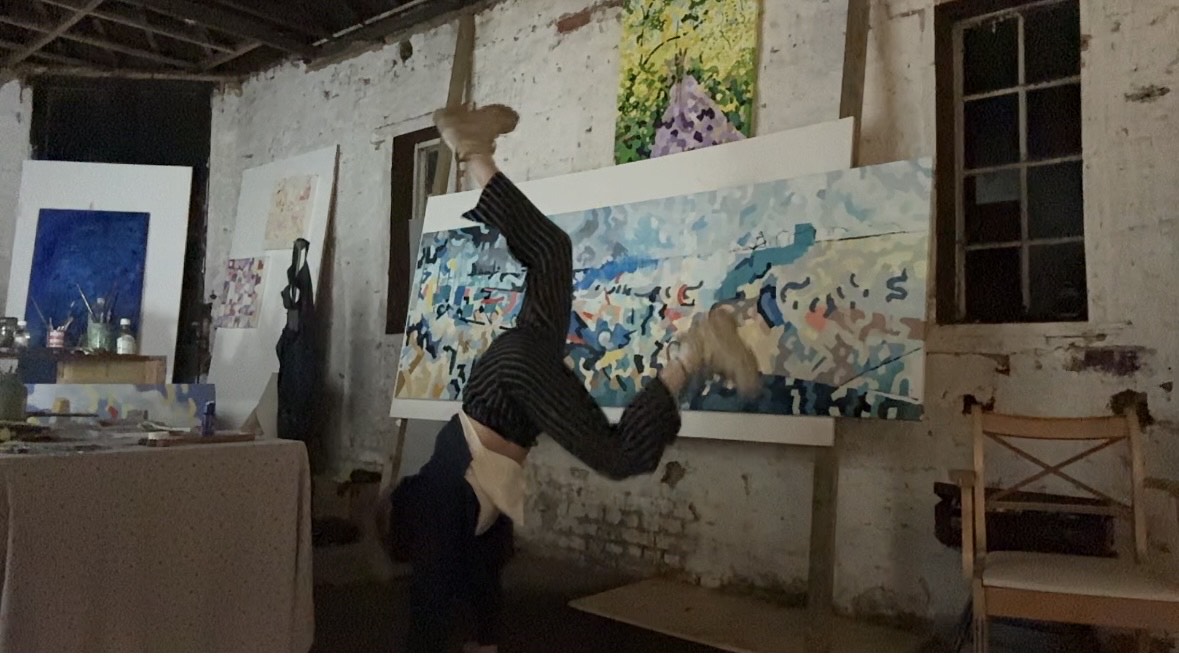
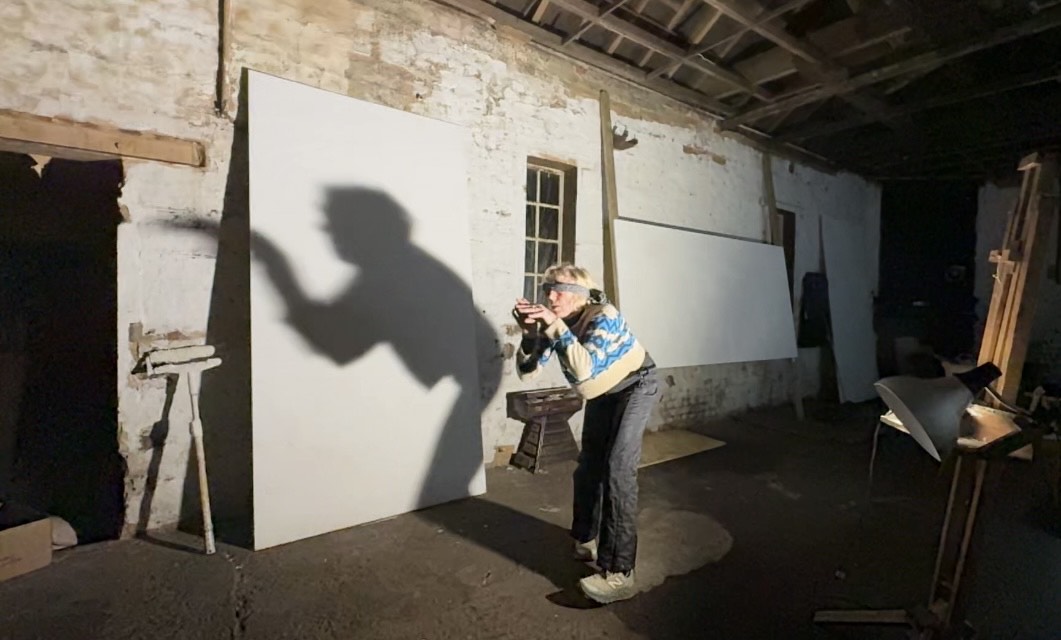
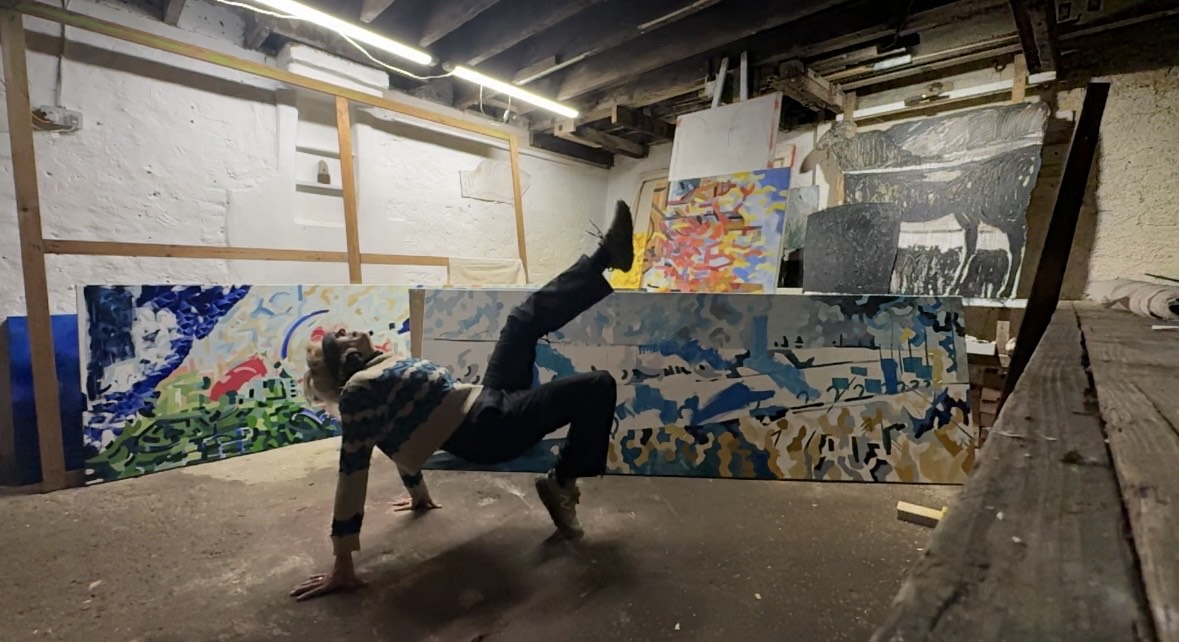
I have also been dancing in my studio while blindfolded as a way of exploring the vulnerability of being in a space you know well but without vision. I am exploring seeing with my ears- hence the photos attached.
Some of the work you are exhibiting will involve soundscapes – can you tell us about this?
While painting the pictures I thought it would be fun to create a soundscape of the painting too. My friend Alex Wykes from Verri Media is a film- maker, and he has helped me create soundscapes to go with the paintings. Our plan is to project the sound down over each painting so that the observer can listen and look at the same time.
What other artists most interest and influence your practice?
Kandinsky is a great influence on my art, as is Miro, Chagall and Jackson Pollock. Recently Peter Doig and Chis Ofili have been big influences too.
Can you tell us a bit about the place you are exhibiting in?
The building is an old Smithy, where blacksmiths used to put shoes on horses. It has a huge door to let the horses in. I’ve done a painting of the sounds of the Smithy too, using old footage of a smithy to create the idea of the soundscape (I haven’t yet made a soundscape of the smithy!). Hugo’s space next to mine is an old Forge, where the metal would have been melted down. The modern bit next to us where other artists in our group are showing is a 1960s building used for various industries.
How did your career as a fine artist begin?
I studied English Literature at Cambridge University, then went to University of East London to study Fine Art. While I was there I worked at Pentonville Prison as Artist in Residence, then at Friends School Saffron Walden as Artist in Residence, then at Queenswood School in Hertfordshire as Artist in Residence. All of these residencies allowed me to deepen my understanding of painting as I had a lot of freedom to paint. After that I worked as a mural painter for some years in Hertfordshire, then came to Sussex and have been painting in Hurstpierpoint and Brighton ever since. I lead regular painting holiday groups abroad – sign up if you want to come to Ithaca next year!
What do you most enjoy about taking part in the Artists Open Houses?
I love meeting all the people that come in and meeting the other artists too!
Is there anything else you would like to tell us?
The first weekend of the Open House won’t be fully ready with the sound system. Please come to the Private View on Friday 5th December 6.30 pm to 8.30 pm if you can, or come to the show that weekend (6th and 7th Dec) or the following weekend ( 13th and 14th Dec).
There will be a performance at the Private View by Edmund Lloyd-Winder and Montel Oke at 7pm
Visit: The Infinite House
3, College Place, Brighton, Brighton, BN2 1HN
www.ellaberthoud.com/